Detonation Explained: What Knock Actually Is and Why It Kills Engines
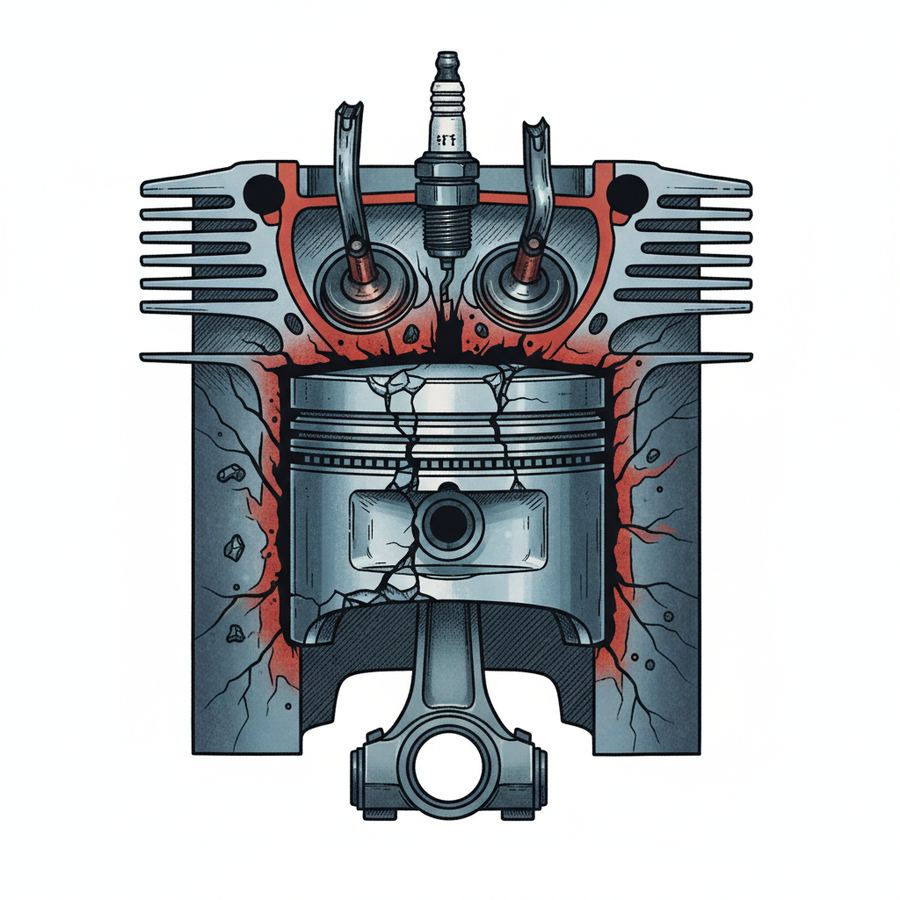
Detonation is the word that makes tuners nervous. It should make you nervous too. It is the single fastest way to destroy a perfectly good engine, and it happens in milliseconds. If you are running a tune on any car, you need to understand what detonation actually is, why it happens, and how to keep it from ever reaching a level that matters.
Detonation vs Pre-Ignition: They Are Not the Same Thing
People use these terms interchangeably, but they describe two different failure modes.
Detonation (knock) happens after the spark plug fires. The flame front starts expanding normally, but the remaining unburned air-fuel mixture in the combustion chamber gets compressed and heated by that expanding flame. If conditions are wrong, that remaining charge ignites spontaneously before the flame front reaches it. You now have two flame fronts colliding. That collision creates a pressure spike and the characteristic "pinging" sound. This is knock.
Pre-ignition happens before the spark plug fires. A hot spot in the combustion chamber (glowing carbon deposit, overheated spark plug tip, sharp edge on a valve) ignites the mixture too early. The piston is still coming up on the compression stroke when combustion starts, so it is fighting against the pressure. Pre-ignition is actually more destructive than detonation because it can create cylinder pressures that are completely off the charts. Sustained pre-ignition on a turbocharged engine will melt pistons in seconds.
Modern knock sensors detect detonation. They generally cannot detect pre-ignition until the damage is already catastrophic. This is one reason why tuning with margin matters so much.
Why Detonation Happens
Knock is a function of pressure, temperature, time, and fuel resistance to autoignition. Here are the main contributors:
Lean air-fuel ratio. Less fuel means higher combustion temperatures. Higher temperatures mean the end gases are more likely to autoignite. This is why running lean on a boosted engine is extremely dangerous. A tune that goes from 11.5:1 AFR to 12.5:1 under full load on a turbo car can cross the line from safe to destructive.
Excessive ignition timing advance. More timing means peak cylinder pressure happens earlier in the power stroke. That gives the unburned mixture more time at high pressure and temperature. There is a point of diminishing returns where more timing stops making more power and starts making knock.
High intake air temperatures. Hot air is denser in terms of energy content but also closer to autoignition threshold. This is why intercooler upgrades are not just about making more power. They are about knock margin.
Low fuel quality. 87 octane has less resistance to autoignition than 93. If your tune is calibrated for 93 and you fill up with 91 because the station was out, you have reduced your knock margin. Ethanol blends (E85, E30) resist knock extremely well, which is why they are popular in the performance world.
High compression ratio. More compression means more heat and pressure before the spark even fires. Forced induction engines effectively raise compression through boost pressure, which is why a stock 9.5:1 compression turbo engine on 20 psi of boost has very different knock behavior than a naturally aspirated 10.5:1 engine.
Carbon buildup. Carbon deposits act as hot spots and also effectively raise compression ratio by reducing combustion chamber volume. This is a common cause of knock on direct injection engines with 60,000+ miles.
What Knock Sensors Actually Do
Knock sensors are piezoelectric accelerometers bolted to the engine block. They detect the specific vibration frequency that knock produces (typically 5-15 kHz depending on bore diameter). The ECU filters the signal, compares it against background noise, and if it detects knock, it pulls timing.
This is the knock retard value you see in your datalog. The ECU is saying "I heard something, I am pulling 2 degrees of timing to be safe." On most platforms, it will add timing back gradually once the knock event stops.
Knock sensors are good but not perfect. They can false trigger from injector noise, valvetrain noise, or exhaust leak vibrations. They also have a response time. By the time the sensor detects knock, pulls timing, and the engine responds, you have already had several knock events. A tune that relies on the knock sensor as the primary safety margin is a tune built on thin ice.
Common Knock Thresholds by Platform
| Metric | Generally Safe | Caution | Dangerous |
|---|---|---|---|
| Knock retard (GM) | 0-1.4 degrees | 1.4-3.5 degrees | 3.5+ degrees sustained |
| Knock retard (Subaru) | 0-1.41 degrees | 1.41-2.81 degrees | 4.22+ degrees |
| Feedback knock (Subaru) | -1.41 degrees occasional | -2.81 sustained | -4.22+ degrees |
| Knock count (Ford EcoBoost) | 0-2 per pull | 3-5 per pull | Consistent counts every pull |
| Ignition correction (BMW) | 0 to -1 degrees | -2 to -4 degrees | -5+ degrees |
These are general guidelines. Every engine, tune, and fuel combination is different. The numbers mean nothing without context from proper datalogging.
How to Avoid Knock on Street Tunes
A good street tune builds in margins that account for real-world variables. Here is what that looks like in practice:
Run conservative timing. A street tune should leave 2-4 degrees of timing on the table compared to what the engine could theoretically tolerate on perfect fuel on a cool day. That margin is your insurance for hot days, bad gas, and carbon buildup.
Target slightly rich at full load. On a turbocharged gasoline engine, lambda 0.78-0.82 (roughly 11.5-12:1 AFR) at wide open throttle is typical for a safe street tune. The extra fuel cools combustion and adds knock margin. Running leaner makes more power but removes that safety net.
Use the right fuel. If your tune is for 93 octane, run 93 octane. Every time. No exceptions. Better yet, get a flex fuel tune and run E30 or higher when you can. The knock resistance of ethanol gives you margin that octane alone cannot match.
Keep your intake temps down. If you are making serious boost, a good intercooler is not optional. Heat soak on a hot day with a stock intercooler is one of the most common causes of knock events on modified turbo cars.
Datalog regularly. A tune that was safe when it was flashed can become unsafe as conditions change. Carbon buildup, a failing fuel pump, a boost leak, or even seasonal fuel reformulation can shift your knock threshold. Pull a third gear log every few weeks and watch your knock retard values.
When Knock Becomes an Emergency
Occasional light knock that the ECU catches and corrects is part of normal operation. Even stock cars experience it. The danger is sustained or heavy knock that overwhelms the ECU's ability to compensate.
If you are seeing consistent knock retard above 3-4 degrees on every pull, or if knock retard is not recovering between pulls, something is wrong. Back off immediately. Lower your boost, pull timing, or go back to a safer map until you can figure out the cause.
Detonation that you can actually hear as audible pinging from outside the car is severe. At that point, the knock sensor has likely already been pulling maximum timing and it is still not enough. Do not drive the car hard until the issue is resolved.
Understanding detonation is not optional if you are running a modified engine. It is the fundamental failure mode that every tuning decision revolves around. Respect it, build margin against it, and choose your tuner carefully.