Suspension Upgrades for Street Cars
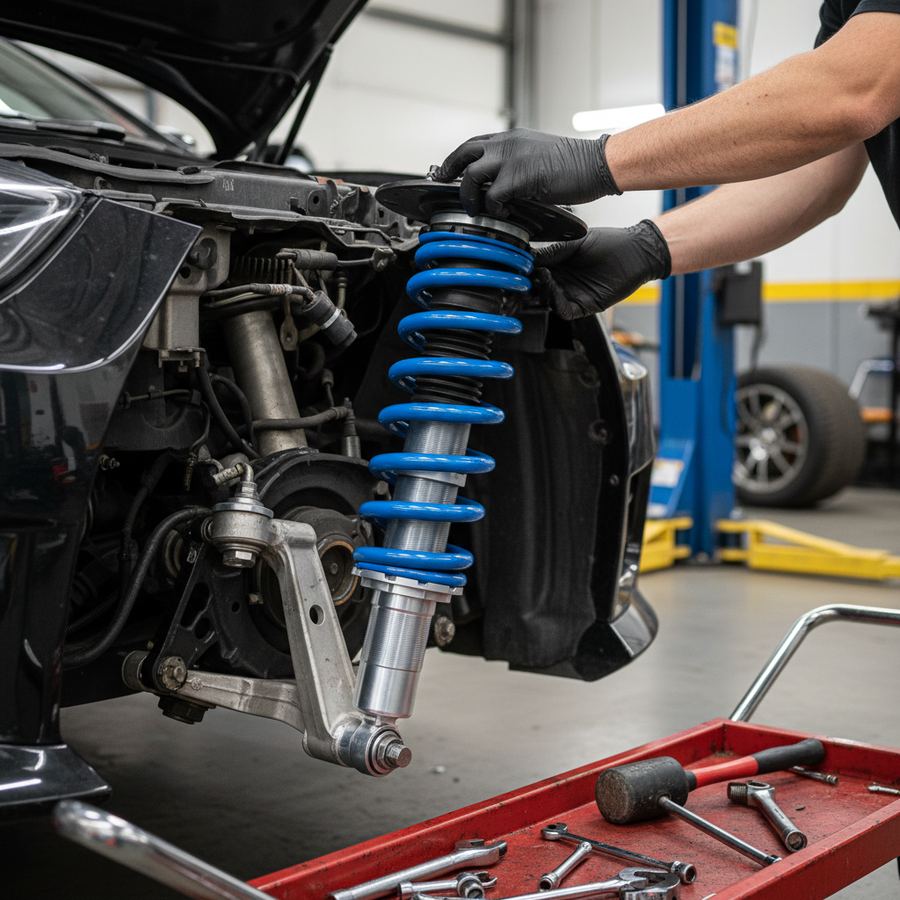
Suspension is where most car builds start, and where a lot of them go wrong. Lowering a car looks great and can genuinely improve handling by dropping the center of gravity. But every change you make to ride height, spring rate, or damping affects a chain of other things: camber, toe, roll center height, bump travel. Ignore those and you end up with a car that looks good in photos but rides like a shopping cart and eats tires for breakfast.
The goal on a street car is to improve body control and turn-in response without making the car miserable to drive every day. That is a narrower window than most people think.
Coilovers vs. Lowering Springs
Lowering springs are cheaper and simpler. You keep your factory struts or shocks, bolt on shorter and stiffer springs, and the car drops an inch or so. The ride gets firmer, body roll decreases, and if the springs are well-matched to the factory dampers, it works fine. The problem is that factory dampers are valved for factory spring rates. Stiffer springs on stock shocks can cause the dampers to wear out faster and the ride to become bouncy once they start failing.
Coilovers give you adjustable ride height, matched spring rates, and (on decent units) adjustable damping. You are getting a complete system designed to work together. The trade-off is cost. A quality set of coilovers from a company like KW, Bilstein, or Fortune Auto runs three to five times the cost of a spring set.
Spring Rate Basics
Spring rate is measured in pounds per inch (lbs/in) or kilograms per millimeter (kg/mm). A higher number means a stiffer spring. Stock rates on most sport sedans are somewhere around 250-400 lbs/in front and 200-350 lbs/in rear. Street coilovers typically bump those to 400-600 front and 300-500 rear. Going much stiffer than that on public roads means you are building a track car, not a street car.
Alignment After Lowering
This is non-negotiable. When you lower a car, the geometry changes. The control arms sit at different angles, which pulls the wheels into more negative camber and can shift the toe settings. If you skip the alignment, you will chew through tires unevenly and the car may pull or track poorly on the highway.
Most factory suspension does not have camber adjustment. On many platforms, lowering 1.5 inches or more requires aftermarket camber arms or adjustable top mounts to bring camber back into a reasonable range. Budget for these when you budget for coilovers. They are not optional. A proper post-lowering alignment is one of the most important steps in any suspension build.
Sway Bars and End Links
Sway bars (anti-roll bars) control body roll without making the ride harsher over bumps. A thicker rear bar reduces oversteer tendency on front-wheel-drive cars and makes rear-drive cars more neutral in transitions. Adjustable sway bars let you fine-tune the balance.
If you upgrade sway bars on a lowered car, upgrade the end links too. Stock end links are often too long once the car is lower, which preloads the bar and affects how it works. Adjustable end links solve this.
What Actually Improves Street Handling
In order of impact for a daily-driven car that sees spirited driving:
- Tires: Better rubber on stock suspension beats stock rubber on fancy coilovers. Always.
- Sway bars: Biggest improvement to body control without sacrificing ride quality.
- Quality coilovers or springs: Lowers the center of gravity and tightens body control further.
- Rear subframe and chassis bracing: Reduces flex in the chassis that your new stiffer suspension exposes.
Notice that ride height is not at the top of the list. A car on good tires and upgraded sway bars at stock height will handle better than a slammed car on cheap all-seasons. Build the foundation first.
Ride Quality Considerations
Every millimeter you lower a car costs you bump travel. Bump travel is the distance the wheel can move upward before hitting the bump stop. Run out of bump travel on a pothole and the suspension slams to a hard stop, which is terrible for the chassis and your spine. This is why extremely low cars ride so badly. They are not absorbing impacts, they are crashing through them.
On a street car, keep at least 2 inches of bump travel. This usually means a 1 to 1.5 inch drop is the sweet spot. It looks noticeably better than stock, handles better, and still absorbs the real world. Going lower than that means you are choosing looks over function, which is fine if you understand the trade-off. Just do not pretend the ride quality will be the same. If you are running a stiffer setup, make sure your brakes can handle the increased cornering speeds, and confirm your exhaust still clears at the new ride height.
The SAE technical papers on vehicle dynamics go deep into roll center theory and suspension kinematics if you want the engineering behind these recommendations.
Articles in This Section
- Coilovers vs. Springs for StreetWhen coilovers are worth the money and when springs are the smarter buy.
- Alignment After LoweringWhat changes, what to adjust, and why skipping this step costs you tires.
- Suspension Parts That Improve HandlingSway bars, bushings, braces, and the parts that make the biggest difference.