Cat-Back vs Axle-Back vs Custom Exhaust: What Actually Fits Your Build
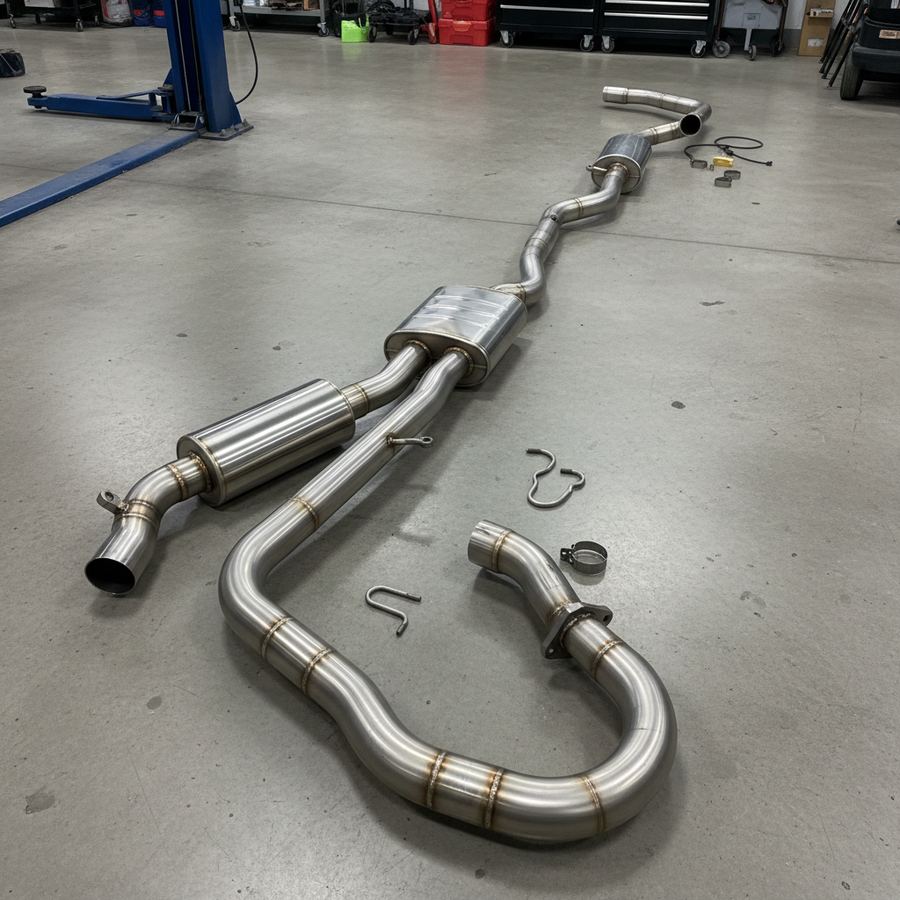
Between cat-back, axle-back, and full custom fabrication, you have three paths that differ in cost, sound, performance, and how much cursing happens during the install. Each one makes sense for a specific situation, and none of them is universally the best choice.
What a Cat-Back System Actually Replaces
A cat-back exhaust replaces everything from the outlet of your catalytic converter to the tailpipe tips. That includes the mid-pipe, resonator (if equipped), muffler, and all the piping and hangers in between. On most cars, that is roughly 60 to 70 percent of the total exhaust length.
This is the most popular aftermarket exhaust option for a reason. It touches enough of the system to change both sound and flow characteristics without getting into emissions-related components. You keep your catalytic converters, which keeps things legal and avoids check engine lights in most cases.
A well-designed cat-back on a naturally aspirated car typically adds 5 to 15 horsepower at the wheels. On turbo platforms, gains can be slightly higher because reduced backpressure helps the turbo spool. But do not let anyone tell you a cat-back alone is worth 30 or 40 horsepower. That is not happening without a proper tune to take advantage of the airflow changes.
Pricing ranges from $600 to $1,500 for quality applications. Budget options exist below that, but you get thinner materials, worse fitment, and welds that look like someone sneezed on the pipe. Mandrel-bent stainless steel is the standard for anything worth buying.
Axle-Back: Less System, Less Money, Less Hassle
An axle-back replaces only the section from the rear axle to the tailpipe tips. On most cars, that means the muffler, the short section of pipe connecting it, and the tips themselves. Everything forward of the rear axle stays stock.
The appeal is simplicity. An axle-back install is usually two or three bolts and a couple of hangers. Most people can do it in their driveway in under an hour. There is no need to drop a mid-pipe or fight with corroded flanges near the catalytic converter.
The downside is limited impact on flow. You are only changing the very end of the system, so power gains are minimal. On most cars, you are looking at 2 to 5 horsepower at best. What you do get is a sound change, and for a lot of people, that is the whole point.
Axle-backs shine on cars that already sound good but are muffled too aggressively from the factory. Mustang GTs, Challenger R/Ts, and similar V8 muscle cars are prime candidates. The engine note is already there. The stock mufflers are just strangling it. Swap to a less restrictive muffler or a straight-through design and you unlock the sound the car should have had from the factory.
Cost is usually $300 to $800. For someone who wants more sound without tearing apart half the underside of their car, it is the right move.
Custom Fabrication: When Nothing Off the Shelf Works
Custom exhaust fabrication means a shop builds the system from scratch using raw tubing, bends, flanges, and your choice of muffler. A fabricator measures, cuts, bends, and welds everything in place on the car.
This is the route for cars that do not have good bolt-on options. If you are running a less common platform, have done an engine swap, or have modifications that change the exhaust routing (like a relocated turbo or a subframe brace that conflicts with stock piping), custom is often the only real choice.
It is also the route for people who want specific characteristics that no shelf product delivers. You can spec the exact pipe diameter, muffler type, resonator placement, and tip style. A good fabricator will build around your car's specific suspension geometry and clearance requirements instead of hoping a universal kit fits close enough.
The catch is cost and variability. A custom system runs $800 to $2,500 depending on complexity and the shop's labor rate. A skilled fabricator with a mandrel bender will build something that fits perfectly and lasts decades. A hack with a chop saw and a MIG welder will build something that rattles, leaks, and looks terrible.
Quality exhaust installation matters as much as the parts themselves. A perfectly designed exhaust system with sloppy fitment will drone, rattle against the underbody, and eventually crack at stress points. Whether you are bolting on a kit or going full custom, the install quality determines whether you enjoy the result or regret it.
Sound: The Part Everyone Cares About Most
Most people shopping for an exhaust care about sound first and everything else second. That is fine, but it helps to understand what controls the tone.
Resonators control drone and smooth out the note. Mufflers control overall volume. Pipe diameter affects depth versus rasp. Smaller pipes on a bigger engine sound raspier at high RPM because gas velocity is higher. Larger pipes let the engine breathe but can sound hollow at low RPM. Cat-backs give you the most control because you are replacing the entire system downstream of the cat. Axle-backs only change the muffler section, so the mid-pipe resonator still shapes the tone.
A common mistake is deleting the resonator for maximum volume. That works on some cars and sounds terrible on others. Four-cylinder and V6 cars almost always benefit from keeping a resonator in the system. Without one, you get a raspy, buzzy sound that most people hate after two weeks of daily driving. V8s are more forgiving, but even they can develop an unpleasant drone at highway speeds without proper resonance management.
Flow and Power: What the Numbers Actually Look Like
Exhaust flow matters, but it is overstated for street cars. The stock exhaust on most modern vehicles is not as restrictive as the aftermarket industry wants you to believe. Where flow improvements matter most is on cars with supporting modifications pushing airflow well beyond factory levels. At that point, a properly sized cat-back or custom system is necessary, not optional.
For a car with bolt-ons and a tune making 10 to 20 percent more power than stock, the gains from an exhaust upgrade are real but modest. You are picking up a few horsepower and a lot of sound.
Pipe diameter matters. Going too large hurts low-end torque because exhaust gas velocity drops. A 2.5-inch system is right for most four-cylinder cars under 350 horsepower. A 3-inch system suits V6 and V8 cars up to around 500 horsepower. Beyond that, you are into 3.5-inch territory, and you should probably have a fabricator involved anyway.
When Each Option Makes Sense
Choose an axle-back if you want a sound change with minimal install effort and cost, you are happy with the flow characteristics of the stock mid-pipe, or your car is a V8 that just needs the mufflers opened up.
Choose a cat-back if you want both a sound and flow improvement, you are making moderate power above stock, or you want a complete matched system designed for your platform. This is the right call for most modified street cars.
Choose custom fabrication if your car does not have good bolt-on options, you have done modifications that change the exhaust routing, or you want precise control over every aspect of the system.
And regardless of which route you pick, make sure the install is done right. A good system with a bad install will always disappoint. Take the time to check hanger alignment and clearance before you button everything up and go for that first drive.